
Chapter
Audit your harness
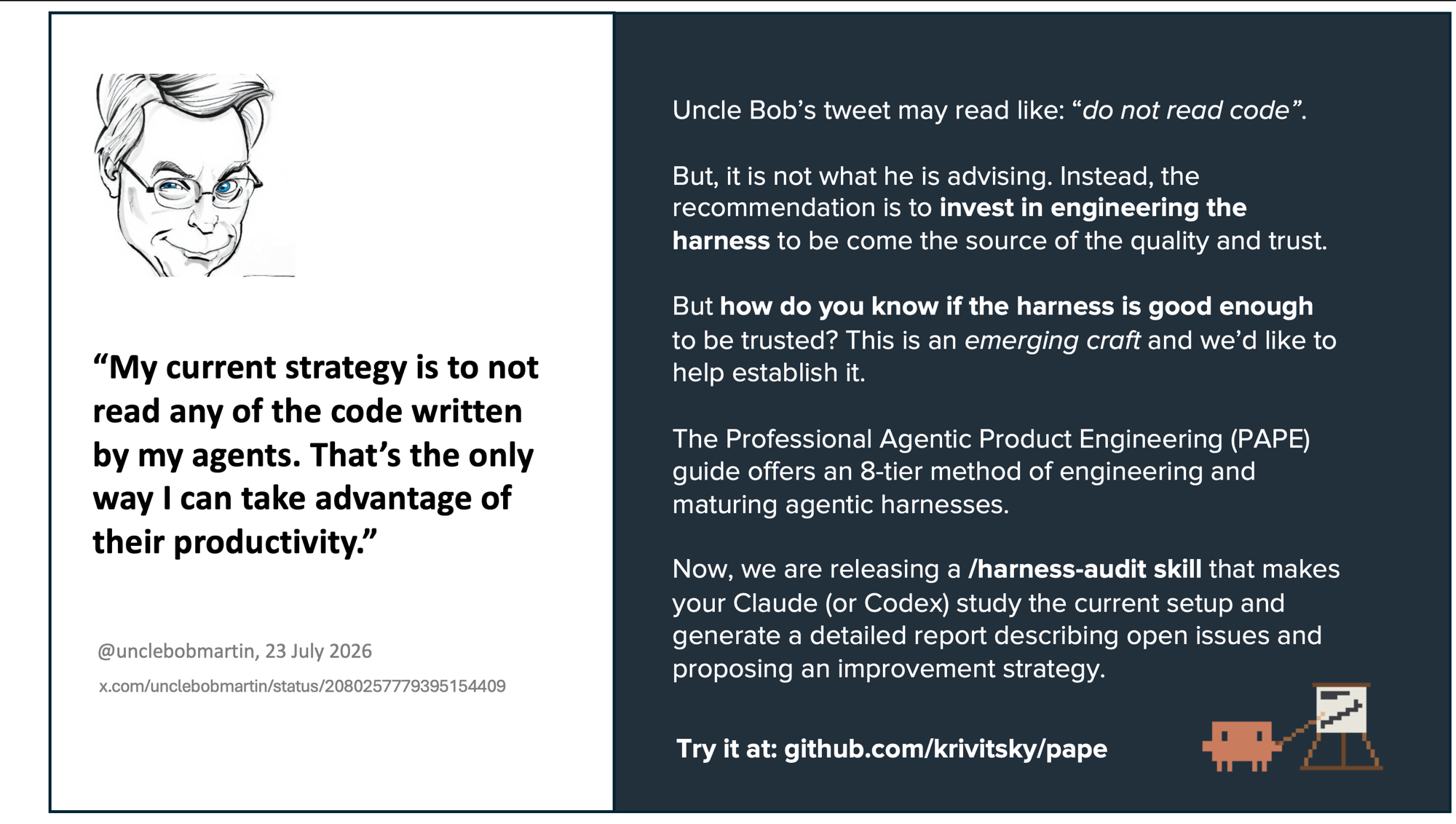
We all saw this powerful yet controversial tweet from Uncle Bob (aka Robert C. Martin), the author of Clean Code. Let me pause here and explain the depth of this and an interesting development that follows.
When Uncle Bob says "he no longer reads the code his agents write", that is not a recommendation to stop reading code and start being careless. It is a call to invest in the agent's harness so you can trust its outputs.
Which leaves the question: how do you know whether your own harness is any good? Where is it strong, where does it leak, and what should you build next?
In response to growing awareness of the need for a guide for Professional Agentic Product Engineering (PAPE), we developed a harness audit skill.
Run /pape:harness-audit to read the repo's existing agentic setup and generate a detailed 8-tier report based on the PAPE guide. The detailed report (md and html) will explain the strengths and weaknesses of your setup. It will then detail and prioritize the outstanding issues and propose a draft backlog to start fixing them.
Every finding names the file and line it came from and cites the tip behind it. Before a finding ships, a separate agent opens that file and tries to refute it; the report says what got cut.
It rates the eight tiers and names one next step
The report rates each of the eight tiers and adds a line explaining the rating. It then walks the tiers from T1 upwards and names the lowest one that does not hold yet. That tier is the recommendation.
The reason is the ladder itself: each tier builds on the ones below, so a weak lower tier limits what the ones above it can do. Hardening CI while nothing tells the agent what "done" means is work on a tier that cannot hold.
"T1 and T2 hold, so the next lever is T3. T4 and T5 are weak too, but both rest on T3, so it goes first."
Where a tier does not apply — nothing runs unattended, so there is no fleet to operate — the report says what that tier depends on instead of counting it as a gap. This guide's advice is to climb only as far as your work needs, and the audit follows it.
What the report contains
Two files per run, written to harness-audits/ — one for you, one for an agent picking up where the audit stopped. The human report runs in this order, decisions first and evidence last:
| § | Section | What it's for |
|---|---|---|
| 1 | Scorecard | The eight tiers rated, what's genuinely good, and the next lever. The only section that says several findings are really one thing. |
| 2 | Issues Summary | Severity counts, then one table: ID, finding, tier, severity, confidence. The whole audit at a glance. |
| 3 | Recommended backlog | One flat ranked list — worst first, and within each severity the lower tier first, so a High on T3 goes before a High on T5. |
| 4 | Trend | What changed since the last run: fixed, still open, newly found, or withdrawn because the earlier finding didn't hold. |
| 5 | Observations | Things worth knowing that need no response. Explicitly labelled as such. |
| 6 | Method and limits | What was read, what was looked for and absent, what this method cannot see at all, and the questions left open. |
| 7 | Issues | The long appendix — every finding with its evidence, its cited tip, and two proposed fixes. Last, because every reference to it is a link. |
Commit the folder. The second run compares itself against the first, so §4 tells you what actually moved rather than what you meant to do.
Install and run it
/plugin marketplace add krivitsky/professional-agentic-product-engineering
/plugin install pape@pape
/reload-plugins
Then, in any repo you work in:
/pape:harness-auditIt asks how deep to go and what output you want, then writes the two files when it's done. It is read-only apart from those files: it never edits your code, runs your tests, or touches git.