
Chapter
Big Idea 💡: From Prompts to Systems
Professional agentic engineering is not prompt engineering. It's engineering the system around the model.
vibe coding
Prompt after prompt, the model churns out code — the product sprawls, features drift, and quality slides into slop. Human intelligence is spent operating the model: all motion, little impact.
agentic system
The model runs inside a harness — workflows, guidelines, autotests, and guardrails — bouncing cleanly within well-engineered bounds. Human intelligence is freed for what matters: growing understanding and driving the impact of the work.
by Alexey Krivitsky, adapted from Denis Turkov
agentic-engineering.guide

Prompting alone is vibe coding: you poke the model and hope it converges. It can — but only under constant hand-steering, and left to prompts alone the product sprawls, features drift, and quality slides into slop, while your own attention drains into operating the model.
An agentic system puts the same model inside a harness: a workflow — the loop it runs — bounded by three constraints. Guidelines shape how it should behave, autotests give it ground truth from the environment, and guardrails are the limits it can't cross. Inside those bounds the model converges on its own, and your attention is freed for what actually matters: growing understanding and driving impact.
That's the whole shift. As the work gets harder, your effort moves from wording one prompt to engineering that harness — the prompt shrinks while the system around it grows. The eight tiers are that climb: from a single request (T1) to whole loops running autonomously in production (T8). Learn the ladder and the 62 tips fall into place.
Don't take it on faith — take it from the person who spent two decades telling the industry the opposite.
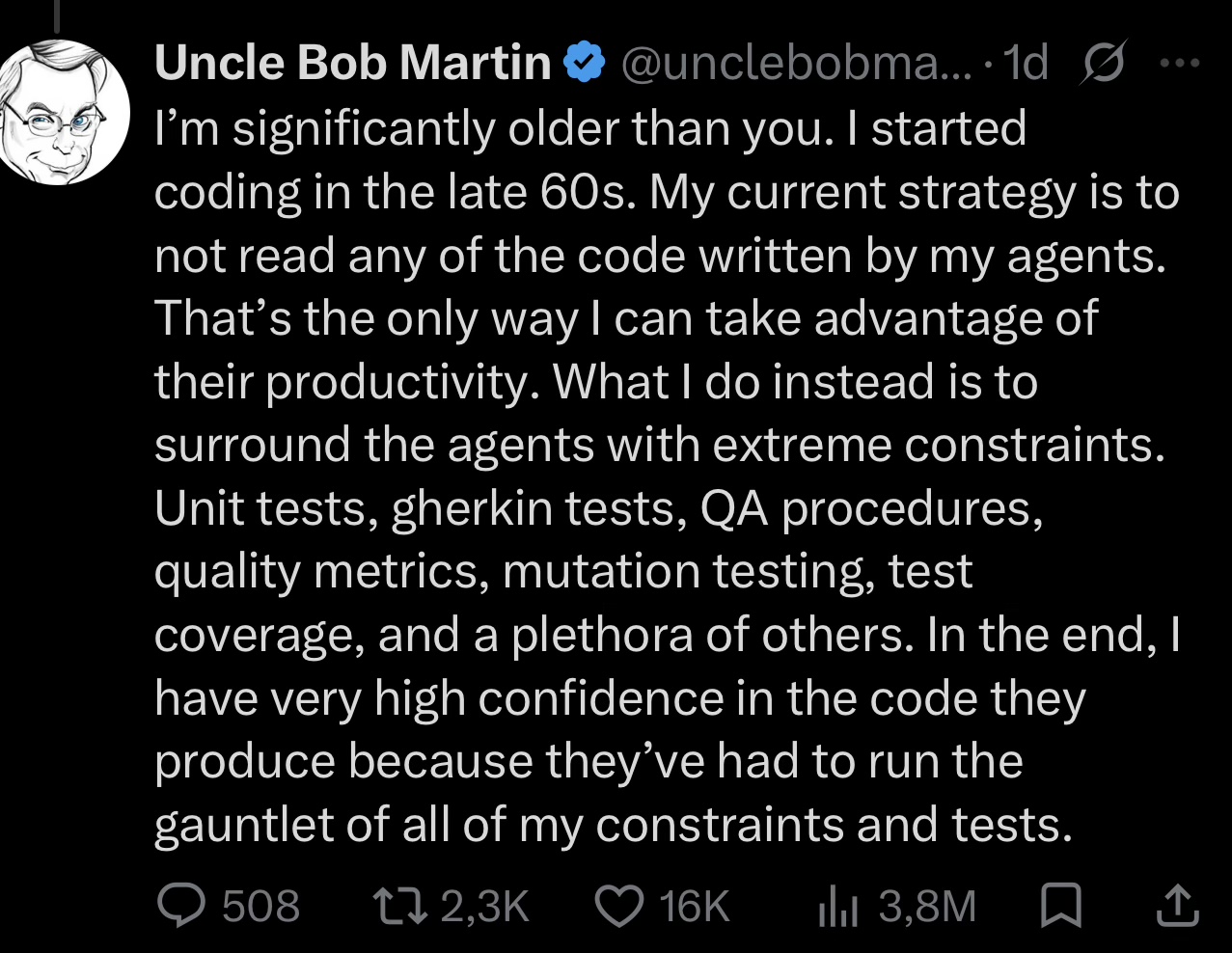
— Robert C. "Uncle Bob" Martin, July 2026
Who's saying it matters as much as what's said. Uncle Bob is a signatory of the Agile Manifesto, the author of Clean Code and Clean Architecture, the one who named the SOLID principles, and for a generation the loudest voice for software craftsmanship and test-driven development. His entire life's work was about the quality of the lines a human writes and reads.
So when he says he no longer reads the code his agents produce — and trusts it anyway — this isn't a hype-chaser cheering a trend. It's the strongest possible version of the Big Idea, from the one person you'd least expect to say it: confidence doesn't come from reading the output; it comes from the gauntlet the output has to survive.
And look at what his gauntlet is made of — unit tests, gherkin/BDD tests, coverage, mutation testing. Those are the craftsmanship disciplines he's preached for twenty years. Craftsmanship didn't die with agents; it moved — from the code you hand-write to the system you build around the model.